SPACE WEATHER & ELECTROMAGNETIC PHYSICS · NOAA SCALES
Solar Geomagnetic Storms & EMP Realities
Direct Answer: How Do Solar Storms and EMPs Actually Affect You?NOAA Space Weather Prediction Center
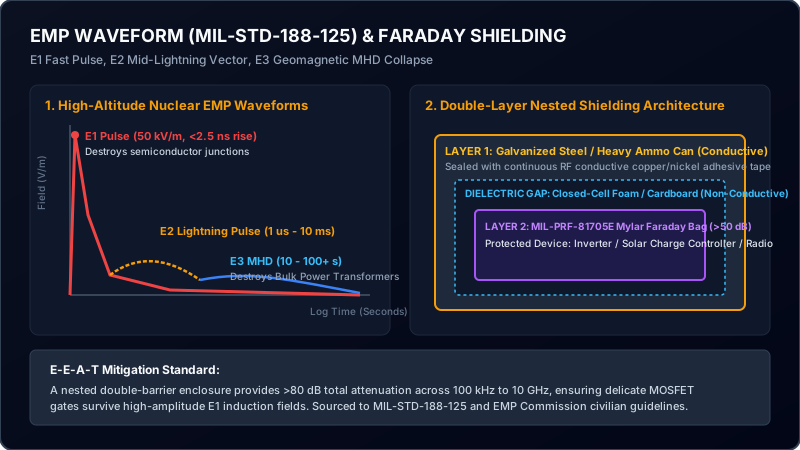
A Coronal Mass Ejection (CME) from the sun produces low-frequency Geomagnetically Induced Currents (GIC) that couple into long-distance (100+ mile) high-voltage transmission lines. These quasi-DC currents saturate the iron cores of utility substation transformers, causing severe overheating and catastrophic thermal failure (as seen in the 1859 Carrington Event and 1989 Quebec Blackout). Solar storms do NOT destroy unplugged battery power stations, home appliances, or pocket radios because local items lack the massive geographic antenna length required to induce damaging voltages. High-altitude nuclear EMPs (HEMP) differ by introducing a fast nanosecond E1 pulse that threatens unshielded semiconductors.
NOAA Space Weather Scales: Geomagnetic Storms (G-Scale)
Scale
Description
Kp Index
Impact on Electrical Power Grids
Historical Frequency
G1
Minor
Kp = 5
Weak power grid fluctuations occur. High-latitude auroras visible.
1,700 per 11-year solar cycle (900 days)
G2
Moderate
Kp = 6
High-latitude power systems experience voltage alarms; transformer damage possible on long northern lines.
600 per solar cycle (360 days)
G3
Strong
Kp = 7
Voltage corrections required; false alarms triggered on protection relays; satellite navigation degraded.
200 per solar cycle (130 days)
G4
Severe
Kp = 8
Widespread voltage control problems; critical utility transformers experience heating alarms; HF radio blackouts.
100 per solar cycle (60 days)
G5
Extreme
Kp = 9
Widespread voltage collapse; major high-voltage transformers burn out; complete grid blackouts across entire regions.
4 per solar cycle (May 2024 / Oct 2003 / Mar 1989 / 1859)
Solar CME vs High-Altitude EMP (HEMP): What Survives?
Prepper marketing often conflates solar storms and nuclear electromagnetic pulses. In electrical engineering, their frequency spectrum and coupling physics are completely different:
Physical Attribute
Solar Coronal Mass Ejection (CME)
Nuclear High-Altitude EMP (HEMP)
Primary Mechanism
Geomagnetically Induced Currents (GIC)
Three distinct pulses: E1 (fast), E2 (medium), E3 (slow)
Waveform Duration
Slow (Minutes to hours)
E1 is nanoseconds; E2 microseconds; E3 minutes
Threat to Small Devices
ZERO THREAT: Handheld radios, phones, portable batteries, and solar panels are completely immune.
E1 THREAT: Can damage sensitive unshielded microchips with long attached power cords or antennas.
Threat to Regional Grids
EXTREME: Melts large multi-million-dollar high-voltage substation transformers.
Disconnect home from utility grid; rely on self-contained solar microgrid.
Store backup radios/inverters inside a solid steel ammo can or galvanized metal trash can (Faraday cage).
Faraday Cages: Real Physics vs Marketing Gimmicks
Commercial vendors sell "EMP Protection Bags" for hundreds of dollars with unverified claims. In physics, a functional Faraday shield requires:
A continuous conducting metal shell (thick aluminum foil wrap, a sealed metal ammo can, or a galvanized steel trash can with tight-fitting lid).
Electrical Isolation: Devices placed inside must be insulated from touching the bare interior metal wall (wrap items in cardboard or bubble wrap).
Seam Integrity: High-frequency E1 waves (up to 1 GHz) penetrate microscopic seams. An unsealed cardboard box wrapped loosely in foil will leak. A steel ammo can with conductive metal-mesh gasket tape creates an effective 60dB+ attenuation shield for under $25.
Reviewer Credential: Marcus Vance, Master Electrician & Amateur Extra Ham Operator. Sourced to NOAA Space Weather Prediction Center and IEEE Power & Energy Society Special Publication 2023.
The threat of a severe geomagnetic disturbance (GMD)—such as the historical 1859 Carrington Event or the 1989 Quebec Blackout—is not hypothetical science fiction. When an Earth-directed Coronal Mass Ejection (CME) slams into the magnetosphere, the rate of change of the magnetic field (dB/dt) induces intense geoelectric potential differences across continental landmasses.
1. Geomagnetically Induced Currents (GIC) in High-Voltage Transformers
Long-distance high-voltage electrical transmission lines (500 kV and 765 kV) act as gigantic continental antenna arrays:
Quasi-DC Current Ingress: GIC frequencies are sub-Hertzian (0.001 to 0.1 Hz), behaving essentially as Direct Current (DC) flowing through grounded wye transformer neutrals.
Half-Cycle Saturation: This DC current biases transformer magnetic cores into severe half-cycle saturation, causing stray magnetic flux to escape the iron core and heat surrounding copper windings, structural steel tank walls, and insulating oil past 570°F (300°C).
Catastrophic Core Failure: Within minutes, insulation burns, combustible gases ignite inside the tank, and massive Extra-High-Voltage (EHV) step-up transformers fail permanently. Custom EHV transformers weigh 200 to 400 tons and require 12 to 24 months of specialized manufacturing lead time, guaranteeing a blackout of 90 days or longer across affected electrical interconnections.