How to Build a 30 to 90-Day Emergency Food Supply: Thermodynamic Math & Long-Term Mylar Preservation
Executive Summary: The Caloric Reality
Most disaster preppers fail their food planning by relying on marketing metrics ("servings") rather than metabolic thermodynamics. An adult engaged in disaster recovery tasks (hauling water, manual sawing, shoveling snow, or living in unheated shelters) burns 2,200 to 2,800 kcal/day.
A true 90-day supply for a single adult requires roughly 200,000 kilocalories, 4.5 kg of bioavailable protein, and a strict balance of essential fatty acids and micronutrients to prevent metabolic crash and scurvy.
1. The Commercial "Survival Bucket" Starvation Trap
Retail "emergency food kits" frequently advertise "30 Days of Food" on the bucket lid. When you inspect the nutritional label, you discover two dangerous deceptive practices:
Trap A: Caloric Deficit
A typical $199 bucket provides 35,000 total calories. Divided across 30 days, that equals 1,166 calories/day. This induces acute metabolic starvation, ketoacidosis, and debilitating fatigue within 10 days.
Trap B: Sugar & Starch Padding
Up to 35% of the claimed calories come from powdered orange drink mixes, sugary puddings, and flavored white rice. Protein levels average 22g/day—less than half the USDA recommended 0.8g/kg baseline.
The Solution: Build your pantry using our open-source caloric model, splitting storage into three distinct shelves: Shelf 1 (Everyday FIFO canned goods), Shelf 2 (Dry bulk commodities in Mylar), and Shelf 3 (Targeted freeze-dried proteins).
2. 90-Day Bulk Commodity Blueprint (Per Adult)
Based on USDA Food Composition Databases, this balanced baseline delivers 2,250 kcal/day and 65g protein/day for 90 days at 1/4th the price of commercial pre-packed buckets.
| Commodity | Weight (lbs) | Total Calories | Total Protein (g) | Storage Vessel | Shelf Life |
|---|---|---|---|---|---|
| White Rice (Enriched) | 50 lbs | 81,600 | 1,600 g | 5-Gal Mylar + 2000cc OA | 25–30 Years |
| Pinto or Black Beans | 25 lbs | 39,000 | 2,450 g | 5-Gal Mylar + 2000cc OA | 25–30 Years |
| Rolled Oats | 20 lbs | 34,400 | 1,180 g | 5-Gal Mylar + 2500cc OA | 20–25 Years |
| Hard Red Wheat / Pasta | 20 lbs | 31,000 | 1,200 g | 5-Gal Mylar + 2000cc OA | 25–30 Years |
| Canned Meats (Tuna, Chicken) | 20 lbs (net) | 11,200 | 2,100 g | Factory Cans (FIFO) | 3–5 Years |
| Pure Vegetable / Olive Oil | 1 Gallon (7.7 lbs) | 31,000 | 0 g | Sealed Tin / Glass | 1–2 Years (Rotate!) |
| Total 90-Day Baseline | ~143.7 lbs | 228,200 kcal | 8,530 g (94g/day) | — | Caloric Surplus Safe |
3. Engineering Protocol: Sealing 5-Gallon Mylar Bags
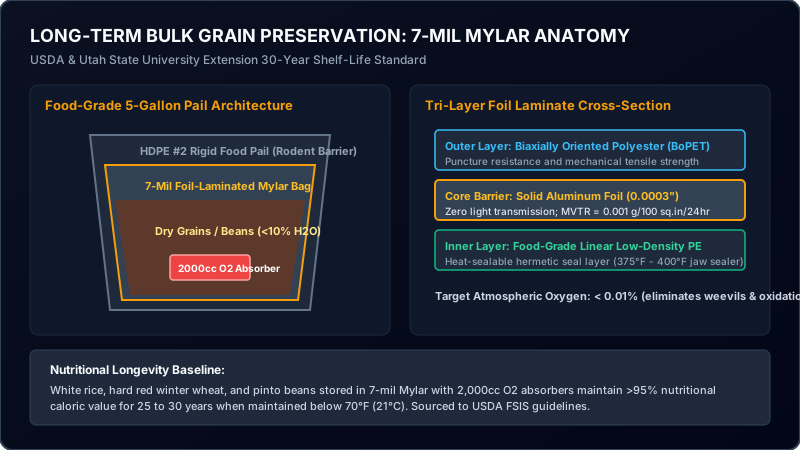
Mylar (biaxially-oriented polyethylene terephthalate, BoPET) with an aluminum foil layer provides an impervious barrier to oxygen and water vapor transmission. Follow this exact protocol:
- Bag Thickness: Use genuine 7 mil or 7.5 mil food-grade Mylar. Avoid 3.5 mil bags, which are prone to pinhole punctures from jagged dry pasta or hard bean edges.
- Fill the Bucket: Place the Mylar bag inside a food-grade, BPA-free 5-gallon bucket (HDPE #2) before filling. Pour the grain until it reaches 3 inches below the bucket rim.
- Pre-Seal: Heat a 1-inch flat clothes iron or hair straightener to 375°F–400°F (Cotton setting). Seal 80% of the bag opening, leaving a 2-inch opening at the corner.
- Insert Oxygen Absorbers: Drop in the calculated oxygen absorber (2,000 cc for dense grains). Do NOT allow absorbers to sit exposed to room air for more than 15 minutes before insertion.
- Final Seal: Press out as much residual head-space air as possible with your hands, then immediately seal the final 2-inch corner with the iron.
- Label & Inspect: Within 24 to 48 hours, the bag should pull tight against the food as atmospheric oxygen (20.9% of air volume) is chemically bound by iron oxide powder. Seal the bucket lid with a rubber gasket.
CRITICAL SAFETY WARNING: Botulism Risk
Never use oxygen absorbers on moist foods, home-dehydrated meats, or any product with moisture content above 10%. In an oxygen-free, anaerobic environment with moisture, Clostridium botulinum spores can germinate and produce lethal botulinum neurotoxin with zero visible odor or discoloration.
Frequently Asked Questions
Why do commercial survival food buckets fail nutritional benchmarks?
Many commercial "30-day supply" buckets provide only 1,100 to 1,300 calories per day, predominantly from refined sugary drink mixes and white rice puddings. Under disaster stress or cold weather, adults require 2,000 to 2,600 calories and at least 50g of protein daily to avoid muscle catabolism and cognitive decline.
How many oxygen absorbers are needed for a 5-gallon Mylar bag?
For dense grains like white rice and wheat berries, use a single 2,000 cc oxygen absorber (or two 1,000 cc packets) per 5-gallon bag. For lower-density, porous foods like rolled oats or pasta that hold more trapped air, use 2,500 to 3,000 cc.
Can you use oxygen absorbers with brown rice, sugar, or salt?
Never use oxygen absorbers with sugar or salt, as removing oxygen turns them into solid rock-hard bricks. Never store brown rice long-term with oxygen absorbers; the high unsaturated oil content in its bran layer causes rancidity within 6 to 12 months regardless of oxygen levels. Store white rice, parboiled rice, or rolled oats instead.